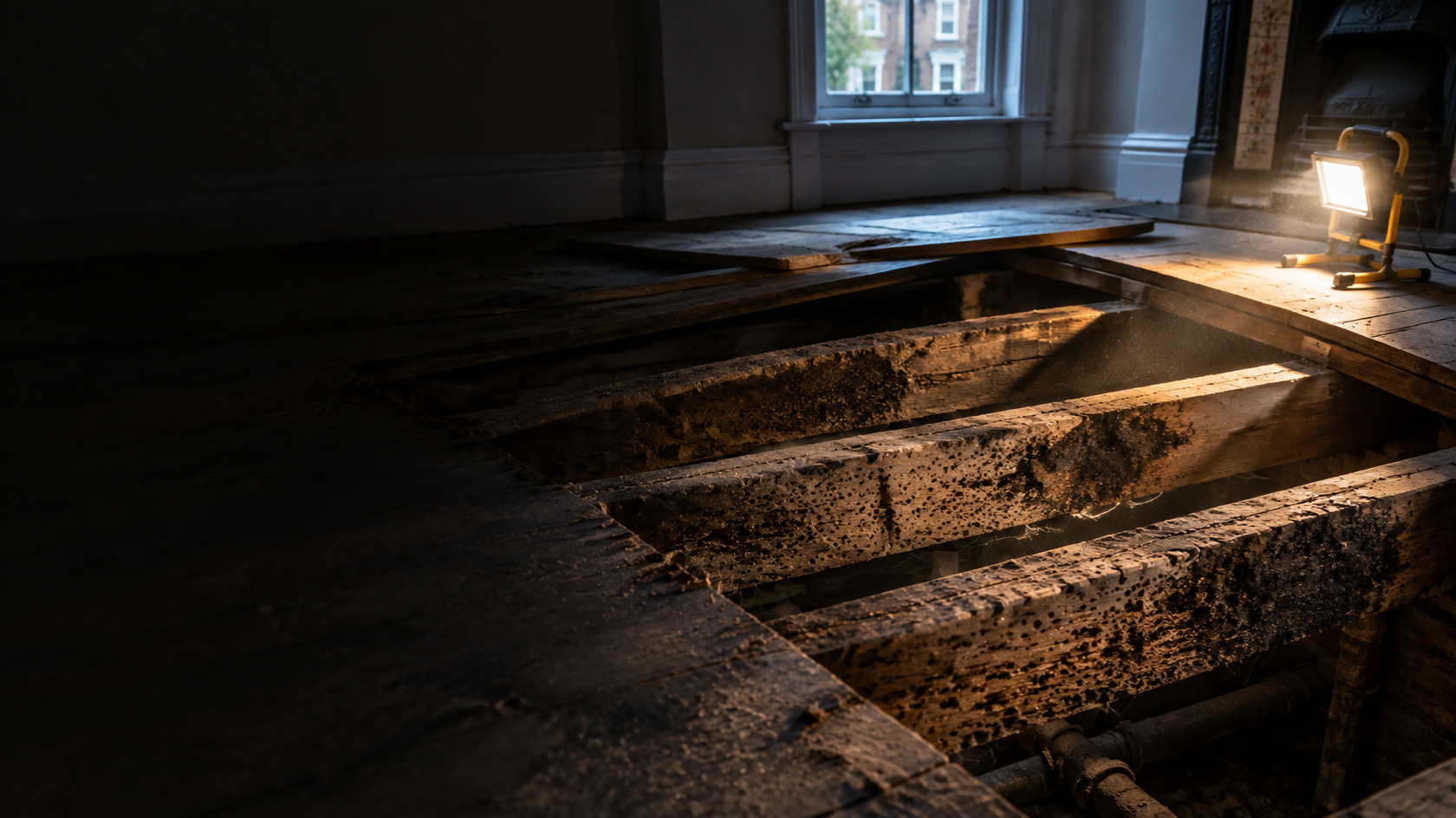
When you need timber treated
- Small round holes and dust in floorboards, joists or roof timbers
- Soft, cracked or crumbling timber
- A musty smell under floors
- Timber near a known leak or damp wall
4.5 from 43 Google reviews
Book a survey- Est. 1978Specialist waterproofing in London
- £10mProfessional indemnity insurance
- 10-yearRenlon guarantee on qualifying works
- CSSW · CSRTCertified surveyors on every survey
Clients and manufacturers
Clients

 Richardsons Nyewood






 Richardsons NyewoodRichardsons NyewoodRichardsons Nyewood
Approved by manufacturers





Signs of woodworm
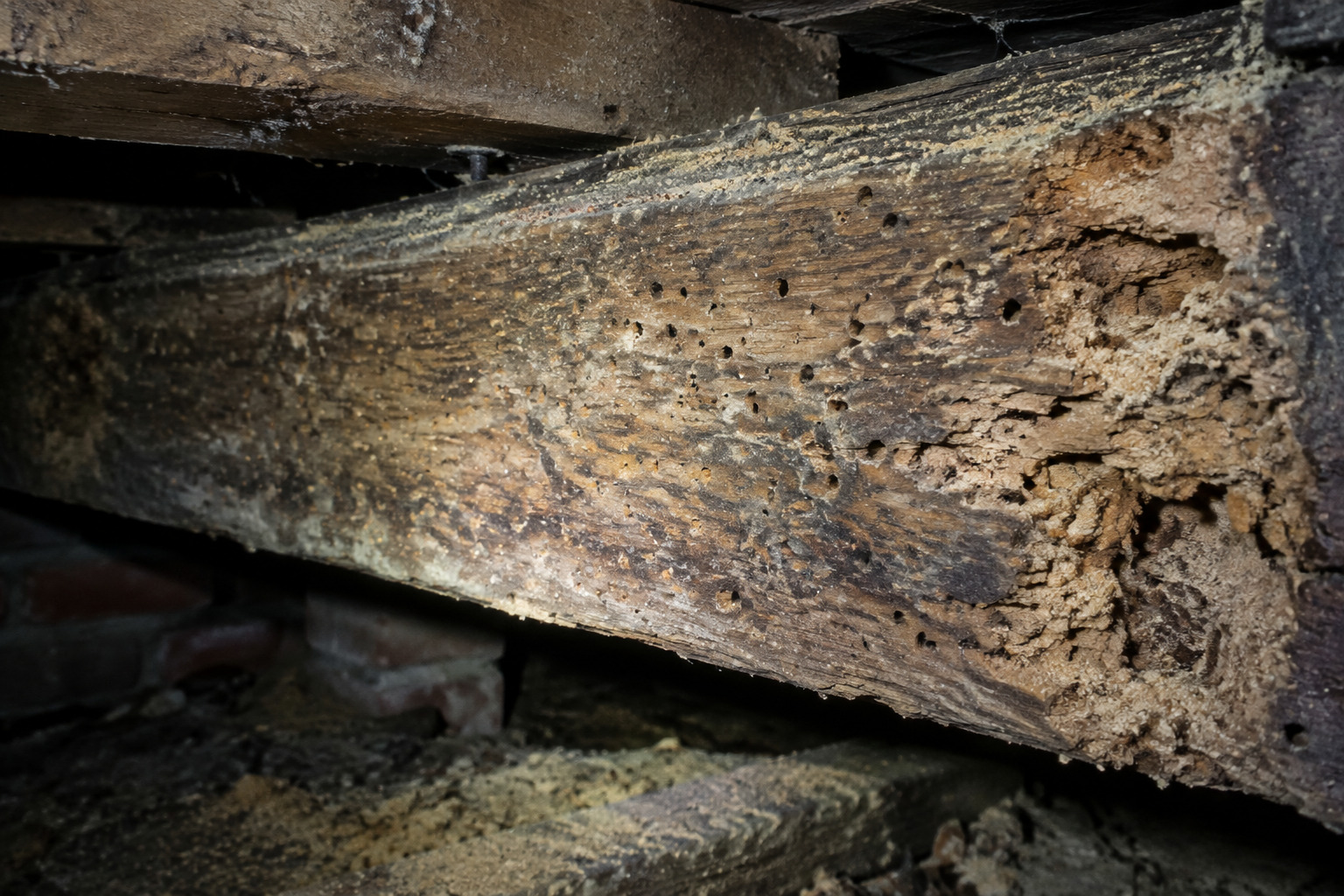
Woodworm, usually the common furniture beetle (Anobium punctatum), completes its life cycle inside timber. An infestation shows as small 2–5 mm holes, often with fine frass dust beneath.
Rot is caused by damp timber. Treating it means finding and stopping the moisture as well as dealing with the affected wood.
Woodworm, wet rot or dry rot?
All three damage timber, but they behave differently and need different treatment. These are the signs our surveyors look for.
| Woodworm | Wet rot | Dry rot | |
|---|---|---|---|
| What it is | Beetle larvae feeding inside the timber, usually the common furniture beetle. | Fungal decay in timber that stays wet. | Fungal decay that can spread through masonry to reach new timber. |
| What you see | Small round holes, often with fine frass dust beneath. | Soft, darkened timber that cracks and crumbles where it is wet. | Dry, brittle timber that cracks into cubes, sometimes with white strands or rust-red dust nearby. |
| Where to look | Floorboards, joists and roof timbers. | Timber near a known leak or a damp wall. | Hidden, unventilated spaces, such as under floors. |
| What fixes it | Treatment that breaks the life cycle, if the infestation is still active. | Stopping the moisture, then repairing or replacing weakened timber. | Tracing how far it has spread, stopping the moisture and treating more widely. |
Woodworm
- What it is
- Beetle larvae feeding inside the timber, usually the common furniture beetle.
- What you see
- Small round holes, often with fine frass dust beneath.
- Where to look
- Floorboards, joists and roof timbers.
- What fixes it
- Treatment that breaks the life cycle, if the infestation is still active.
Wet rot
- What it is
- Fungal decay in timber that stays wet.
- What you see
- Soft, darkened timber that cracks and crumbles where it is wet.
- Where to look
- Timber near a known leak or a damp wall.
- What fixes it
- Stopping the moisture, then repairing or replacing weakened timber.
Dry rot
- What it is
- Fungal decay that can spread through masonry to reach new timber.
- What you see
- Dry, brittle timber that cracks into cubes, sometimes with white strands or rust-red dust nearby.
- Where to look
- Hidden, unventilated spaces, such as under floors.
- What fixes it
- Tracing how far it has spread, stopping the moisture and treating more widely.
These are pointers, not a diagnosis. A qualified surveyor tests the building before recommending any work.
We design it. We install it. We guarantee it.
Diagnosing and breaking the woodworm life cycle, and treating wet and dry rot, so floors, joists and roof timbers stay sound.
Survey
We confirm whether an infestation or rot is active and how far it has spread.
Treat
The right treatment breaks the life cycle or stops the decay.
Repair
Weakened timbers are repaired or replaced where needed.
Prevent
We deal with the damp that caused the problem so it doesn’t come back.
One accountable team since 1978
Our surveyors are certified in structural waterproofing and remedial treatments, our own teams do the work, and qualifying works carry Renlon’s own 10-year guarantee.
See our projects“We recommend Renlon as they are a long-established company with a proven track record. Their surveyors and site operatives consistently deliver to the highest standards on complex programmes.”
Related services
- Rising Damp & Damp-Proof CoursesWater drawn up through brickwork by capillary action, diagnosed by qualified surveyors and treated properly, so you only pay for what the wall needs.
- Basement & Structural WaterproofingSurvey, BS 8102:2022 design and installation of Type A barrier and Type C cavity drain systems, from one accountable team with £10m PI cover and our own 10-year guarantee.
- RoofingPitched and flat roofing: installation, refurbishment, repairs, waterproofing and specialist detailing, managed by the same team as your other works.
Woodworm & Timber Treatment: questions
Quick answers from our surveyors. Still stuck? Email survey@renlon.com and a qualified surveyor replies.
Does every woodworm hole need treating?
No. Old holes can be from an infestation that is no longer active. Our survey checks for signs of current activity, such as fresh frass, before recommending treatment.
What is the difference between wet rot and dry rot?
Both are fungal decay caused by damp timber. Wet rot stays where the timber is wet. Dry rot can spread through masonry to reach new timber, so it needs to be traced and treated more widely.
What causes rot in the first place?
Damp. Treating rot means finding and stopping the source of moisture, such as a leak or a damp wall, as well as dealing with the affected timber.
Will damaged timbers be replaced?
Where they are weakened, yes. We repair or replace affected timbers so floors, joists and roof timbers stay sound.
How do I know if woodworm is still active?
Fresh, pale frass dust beneath the holes is the usual sign. Holes with no dust can be from an infestation that ended years ago. Our survey checks for current activity before recommending any treatment.
Is dry rot urgent?
It should be looked at promptly, because dry rot can travel through masonry to reach timber elsewhere. Our survey traces how far it has spread before treatment is agreed.
Do you deal with the damp as well as the timber?
Yes. Rot starts with damp timber, so we find and stop the source of moisture as well as treating the wood. Our surveyors are qualified in both damp and timber.
Is timber treatment guaranteed?
Qualifying timber preservation works are covered by Renlon’s own 10-year guarantee. The exact scope for your job is set out in your guarantee documents.